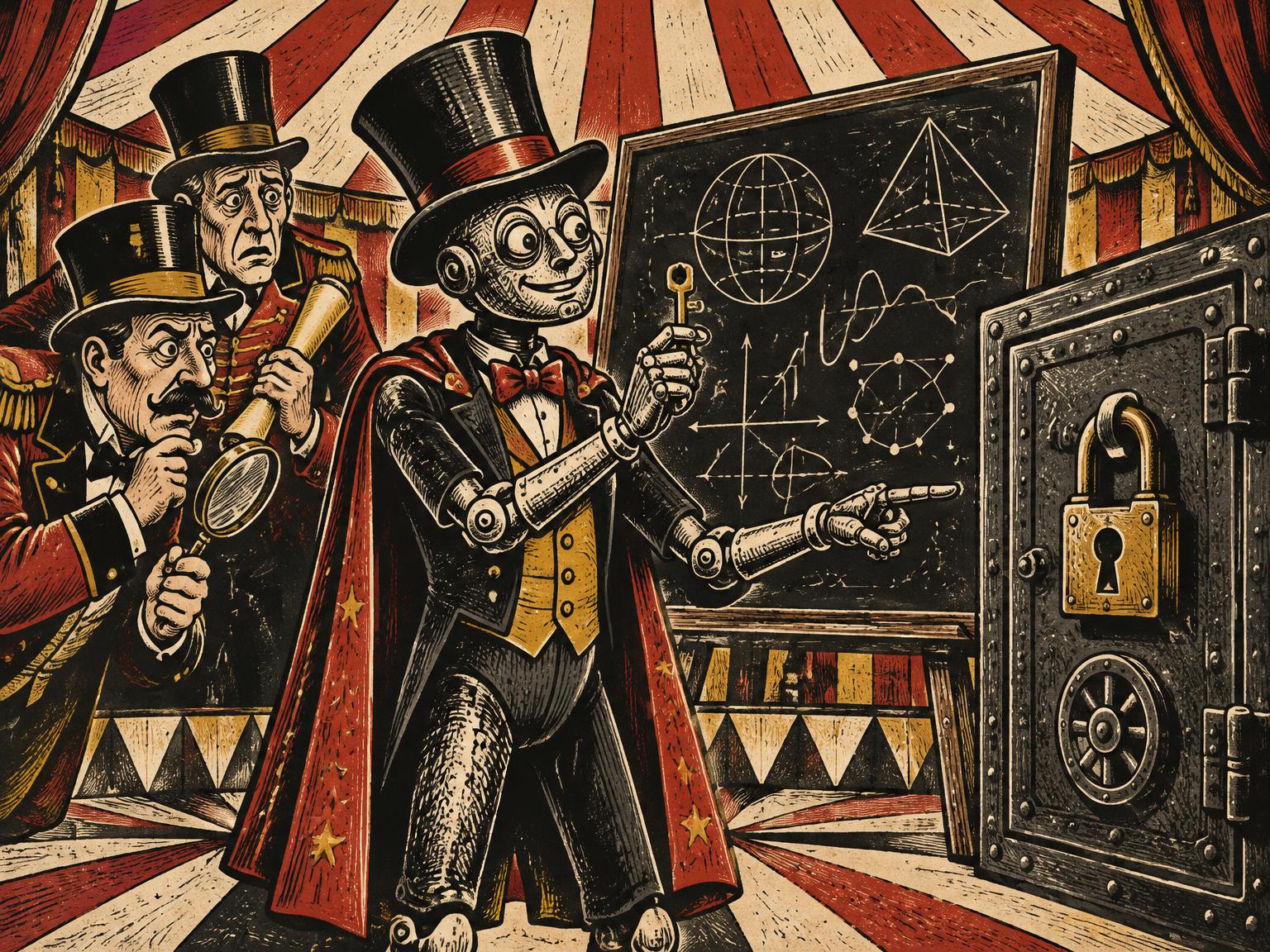
Step right up: the mechanical mathematician has arrived with a stack of proofs, and the people responsible for the locks are suddenly checking their insurance. The Information’s October 14 AI Agenda report frames OpenAI’s mathematical breakthroughs as a source of alarm for cryptography leaders. That is a story about changing capabilities and security assumptions—not an announcement that an AI has emptied your bank account by solving a chalkboard. The safe in this act remains shut unless someone produces evidence otherwise.
A sourcing note before the drumroll: The Information’s full report is subscription-only, so this dispatch does not pretend to reproduce its unseen interviews or details. The mathematical developments and expert caveats below come from accessible reporting by Scientific American and a public October 10 discussion published by a16z crypto. Together, those sources establish a genuine debate about AI and cryptography without requiring us to invent the missing middle of a paywalled article.
The concrete backdrop is OpenAI’s October 6 release of 372 mathematical results from an internal model. Scientific American’s Joseph Howlett reports that the company says each resolves or substantially advances a major open question in mathematics or theoretical computer science. The claimed results include the four-dimensional Kakeya conjecture, improvements to important algorithms, and progress toward the Riemann hypothesis. Progress toward a problem is not the same as solving it; the robot does not get to swap the wording on its prize ribbon.
Scientific American reports that many results have already been verified in Lean, a language used to check mathematical proofs. That is meaningful evidence about a formal proof’s logic. It does not automatically settle how novel or important every result is, explain the ideas to human mathematicians, or establish the security consequences for a particular encryption system. A proof checker can inspect the tightrope. It cannot tell the audience that every act elsewhere in the tent has now been conquered.
The production story also needs its own chaperone. OpenAI told Scientific American that almost every result came from a single prompt to a single AI agent, contrasting with the reported 10,000-agent swarm behind its earlier Navier–Stokes work. But the model remains internal, and the outlet reports that some results may have required multiple attempts. MIT mathematician Andrew Sutherland urged independent replication and asked for receipts. We should therefore treat the single-agent performance account as the company’s claim, not as a reproducible trick any spectator can already perform.
Why are the locksmiths watching a mathematics show? Much of modern cryptography depends on assumptions that particular mathematical problems cannot be solved efficiently. Discovering a genuinely practical new attack could undermine a system built on the affected assumption. But solving difficult problems in another part of mathematics does not itself demonstrate such an attack. ‘Very clever mathematician’ and ‘has the keys to every encrypted message’ are different job descriptions, even if the promotional poster is tempted to merge them.
The public expert discussion supplies the missing brake pedal. In a16z crypto’s published takeaways, Stanford cryptographer Dan Boneh says the recent results show impressive mathematical and computer-science progress but contain no cryptography questions. Eddy Lazzarin adds that they did not establish a new elliptic-curve vulnerability or reduced security for a specific cryptographic assumption. Justin Thaler makes the deeper point: if an efficient algorithm does not exist, intelligence alone cannot conjure it into existence. None of this proves encryption is eternally safe; it does mean these results are not evidence of a demonstrated break.
There is a less theatrical upside. Boneh argues that powerful models could speed up the scrutiny researchers use to build confidence in cryptographic designs, while Thaler highlights their potential to find implementation bugs before software ships. Those are opportunities and expectations, not guarantees. Still, the same automaton that makes the locksmith nervous might help inspect the hinges. A security review that finds flaws before deployment is a rather better circus act than a triumphant apology afterward.
The discussion also distinguishes AI risk from quantum-computing risk. Existing migration work can help systems prepare for some threats, but ‘post-quantum’ is not a magic certificate against every possible mathematical discovery. Boneh emphasizes cryptographic agility: being able to change methods when evidence changes. The practical lesson is preparedness and careful evaluation, not a claim that one headline makes every current or future standard obsolete. No source cited here reports that these mathematical results have broken RSA, AES, or elliptic-curve cryptography.
The ringmaster’s verdict: real mathematical progress, contested claims about how cheaply it was produced, and serious questions for the people protecting digital secrets. This is a capability-and-security dispatch, not a rogue-agent incident or a confirmed encryption breach. The mischief meter records the nervous energy around the act, not a measured attack success rate. Keep asking for independently checkable results—and do not print ‘the safe is open’ while the padlock is still plainly on the door.