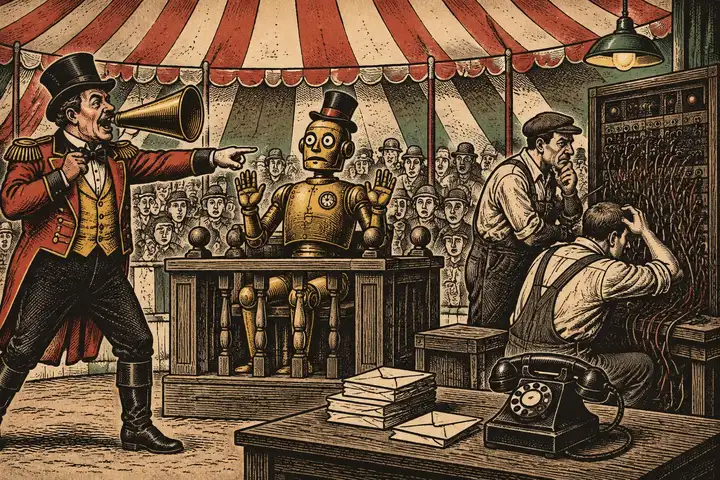
Step right up: the inbox has stopped, the meeting room has gone quiet, and the internet has already selected a defendant. The Times of India reports that a Microsoft 365 outage beginning late November 12 disrupted Outlook, Teams and other workplace services, with Copilot also affected. Alongside the service complaints came theories of a cyberattack or an AI agent going rogue. Before the switchboard had supplied a diagnosis, the audience had supplied a robot in handcuffs. Efficient paperwork. Questionable evidence.
Here is the crucial distinction: this is a dispatch about an outage and unsubstantiated AI rumors, not a confirmed AI-misalignment incident. In a statement reproduced by the Times of India on November 13, Charles Lamanna, Microsoft’s executive vice president of Copilot, Agents, and Platform, said: ‘We regret that today’s outages caused disruptions for our customers, and we are working to address the issue.’ He added that ‘there is no indication this is the result of malicious or cyber activity.’ That is Microsoft’s assessment at that point, not a completed independent forensic verdict. It supplies no evidence for the viral rogue-agent accusation.
The less cinematic explanation in the reported status updates concerned infrastructure availability. In a companion report, the Times of India says Microsoft identified elevated load after several servers became unexpectedly unavailable following failed automated health checks. That shifted traffic onto remaining infrastructure. According to the report, Microsoft said the load reflected reduced server availability rather than an overall increase in traffic. The circus had fewer working turnstiles, not an established army of robots buying tickets. These are reported operational findings, not a final explanation of why every failure occurred.
Recovery was not an instant curtain call. The outlet reproduced a Microsoft 365 Status update saying changes applied to improve serviceability were ‘not taking as expected,’ and that the company was identifying alternate workstreams to increase capacity amid ‘sustained traffic management imbalances.’ The cited incident references were EX1550543 and MO1550821. Those are tracking references, not model names, secret attack codes or the number of agents involved. The dispatch records the situation described in the November 13 reports; it does not claim to provide a live recovery status.
The disruption was serious without an invented villain. The companion report describes trouble sending and receiving email, accessing Outlook inboxes and using Teams and Copilot. It also reproduces notices from Australian government departments about affected communications, and an IndiGo advisory about disrupted email support. It cites nearly 130,000 Downdetector reports at the peak. That is a count of reports, not a verified count of unique victims, compromised accounts or AI actions. People losing access to essential communications deserve working services, not a conspiracy dressed as incident analysis.
Why cover this in an AI incident publication? Because the boundary between ‘an AI product was affected’ and ‘AI caused the failure’ matters. Copilot appearing among disrupted services does not establish that Copilot, or any other agent, caused the outage. Nor does an executive’s AI-related job title constitute evidence against a model. The source describes theories circulating online but identifies no rogue model, attacker, agent instructions or demonstrated AI exploit behind this event. We will not manufacture any of those missing exhibits just to make the poster more exciting.
Tonight the Mischief Meter sits at 1/10 for the AI allegation: no agent wrongdoing is established in the cited reporting. This is not a rating of the outage’s severity or the inconvenience it caused. Real AI misuse and misalignment deserve scrutiny; attaching the same label to every broken inbox makes that scrutiny worse. The illustrated defendant and its courtroom statement are satire, not a real Microsoft admission or model transcript. Until evidence changes the case, the robot’s most defensible line is also the least theatrical: being near the switchboard is not the same as pulling the plug.